
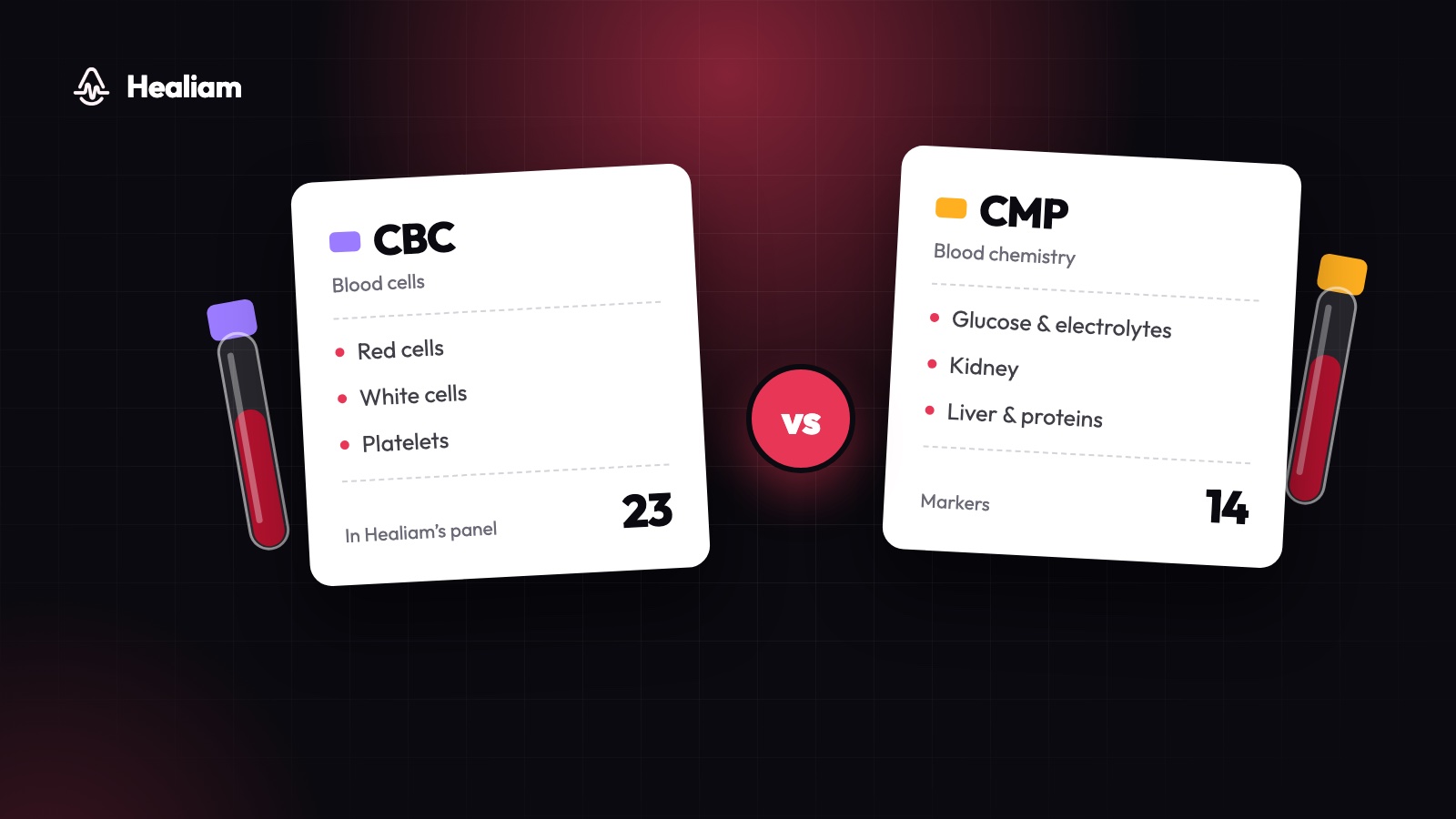
Look at a routine lab order and you’ll often see CBC and CMP sitting next to each other. The names sound alike, so they get mixed up. The real CBC vs CMP difference is what each one examines. The CBC looks at the cells in your blood, the CMP at what’s dissolved around them, and that decides what each can and can’t tell you.
We’ll go through both panels, then the BMP, the CMP’s shorter cousin. If you have a report or an order in front of you, the tables match each result to the panel it belongs to.
What a CBC measures
A complete blood count is about the cells carried in your blood, not anything dissolved in it. MedlinePlus’s page on the complete blood count describes it as a set of tests that count your blood cells and measure their size. A standard report covers three families:
- Red blood cells: the red cell count (RBC), hemoglobin, hematocrit and the red cell indices (MCV, MCH, MCHC, RDW), which show how big the cells are, how much hemoglobin each holds and how much they differ from one another.
- White blood cells: the total count (WBC). A CBC “with differential” also splits that total into the five types: neutrophils, lymphocytes, monocytes, eosinophils and basophils.
- Platelets: the platelet count and mean platelet volume (MPV). Platelets are the cell fragments that plug a cut and start a clot.
Because these are whole cells, the lab counts them in whole blood, kept in a tube that stops it from clotting.
Doctors use a CBC to look for anemia, infection and inflammation, and to follow illnesses and treatments that move blood cell numbers, from immune disorders to blood cancers. A result outside the range is a reason to ask questions rather than a diagnosis: dehydration, a recent cold or a heavy period can shift a CBC too.
What a CMP measures
A comprehensive metabolic panel works on the fluid the cells travel in. The comprehensive metabolic panel guide on MedlinePlus lists 14 substances, and they sort into five groups. Lab orders also call it a chem 14 or a chemistry panel.
| Group | CMP markers | What they tell you |
|---|---|---|
| Blood sugar | Glucose | How much fuel is in your blood at the draw; a high fasting level can point to diabetes |
| Minerals and electrolytes | Calcium, sodium, potassium, chloride, carbon dioxide (bicarbonate) | Fluid balance, acid–base balance, and the signals nerves, muscles and the heart depend on |
| Kidney | Blood urea nitrogen (BUN), creatinine | Two wastes the kidneys clear; higher levels can mean they’re filtering less |
| Proteins | Albumin, total protein | Proteins made mostly by the liver; low levels can follow liver disease, protein loss through the kidneys or a poor diet |
| Liver | ALP, ALT, AST, bilirubin | Enzymes released by strained liver (and some bone or muscle) cells, plus a pigment from old red cells that the liver clears |
Doctors rarely read one of these numbers on its own. Creatinine is judged next to BUN, and ALT next to AST and bilirubin. Our guides to creatinine and BUN and ALT, AST and albumin take them one at a time.
CBC vs CMP side by side
| CBC | CMP | |
|---|---|---|
| Looks at | Blood cells: red cells, white cells, platelets | Substances dissolved in blood: sugar, minerals, wastes, proteins, enzymes |
| Number of results | Varies by lab, more with a differential (Healiam’s has 23) | 14 |
| Sample | Whole blood, kept from clotting | Serum or plasma, the liquid part of blood |
| Fasting | Usually none | Often several hours, because of glucose |
| Main questions | Anemia, infection, inflammation, blood disorders | Glucose, kidney and liver health, fluids and salts |
| Other names | Hemogram, full blood count | Chem 14, chemistry panel, metabolic panel |
The fasting row is the one that catches people out. A CBC alone can be drawn after breakfast, but once a CMP is on the same order, you fast for both.
Does a CMP include a CBC?
No, and they don’t share a single result. They even go in different tubes. The CBC sample has to stay unclotted, while a CMP is usually run on serum, which comes from blood that has clotted. When your doctor wants both, they’re two separate lines on the order, filled from one needle stick.
There is one spot where a doctor might read them together. Bilirubin, on the CMP, is made when old red cells break down, so a high bilirubin next to a low hemoglobin on the CBC can be worth a closer look. Neither report makes that link for you.
CMP vs BMP
A basic metabolic panel is the CMP with six markers taken out. MedlinePlus’s BMP page lists eight, and you may see it called chem 7 or chem 8. What’s left is the blood sugar, electrolyte and kidney part of the CMP, with the liver taken out.
- In both panels (8): glucose, calcium, sodium, potassium, chloride, carbon dioxide, BUN and creatinine.
- CMP only (6): albumin, total protein, ALP, ALT, AST and bilirubin.
You’ll see a BMP in emergency rooms and when someone is being followed for kidney disease or high blood pressure, where the liver isn’t the question. For a general check, the CMP adds the liver and protein results from the same sample.
Do you need both?
At a routine adult checkup the two are commonly ordered together, since they catch different problems.
- CBC: anemia, including the small red cells typical of low iron; infection or inflammation through the white cell count; platelet counts that run low or high; and early hints of bone marrow or blood disorders.
- CMP: high blood sugar, kidneys filtering less than they should, liver strain, sodium or potassium out of balance, and calcium problems.
One panel is enough when there’s a single question. Rechecking hemoglobin after treatment for anemia needs only a CBC. Keeping an eye on potassium while you’re on a blood pressure medicine needs only a CMP or BMP. If nothing in particular worries you, having both gives you a wider baseline, and next year’s numbers mean more with this year’s to compare against.
Neither panel covers cholesterol, thyroid hormones or HbA1c, which reflects blood sugar across roughly the past three months. Those are separate tests, and often the ones people assume a “full” panel includes. Our look at full panel prices at retail labs shows what adding them costs.
How the Healiam panel lines up with a CBC and CMP
Healiam doesn’t sell anything called a CMP. Its single panel is grouped by body system, so the 14 CMP markers are spread over five of its categories, a few of them under different names. All 14 are there:
| CMP marker | Name in the Healiam panel | Healiam category |
|---|---|---|
| Glucose | Glucose | Diabetes |
| Calcium | Calcium | Kidney |
| Sodium | Sodium | Electrolytes |
| Potassium | Potassium | Electrolytes |
| Chloride | Chloride | Electrolytes |
| Carbon dioxide (bicarbonate) | Carbon dioxide | Other tests |
| BUN | Urea nitrogen | Kidney |
| Creatinine | Creatinine | Kidney |
| Albumin | Albumin | Liver |
| Total protein | Total protein | Liver |
| ALP | Alkaline phosphatase | Liver |
| ALT | Alanine aminotransferase | Liver |
| AST | Aspartate aminotransferase | Liver |
| Bilirubin | Bilirubin total | Liver |
Two names differ from a CMP report. BUN shows up as “urea nitrogen”, and carbon dioxide sits under Other tests instead of with the electrolytes. Beyond the 14, Healiam adds direct bilirubin, phosphorus, magnesium, uric acid, creatine kinase and LDH, chemistry markers a standard CMP leaves out.
The CBC section has 23 markers, differential included. On the red cell side: RBC, hemoglobin, hematocrit, MCV, MCH, MCHC, RDW and RDW-SD. On the white cell side: WBC, then neutrophils, lymphocytes, monocytes, eosinophils, basophils and immature granulocytes, most as both a percentage and an absolute count. For platelets: the count, MPV and the immature platelet fraction.
Both come from the same two vials, drawn at a Healiam health fair. On top of the CBC and CMP markers you get lipids, thyroid, HbA1c, iron and vitamin D, 56 lab measurements altogether, for $95. Fast for 8 to 12 hours first. Healiam takes HSA cards as well as regular cards, doesn’t bill insurance and doesn’t ask for a referral. Your numbers appear in the app about a week later (4 to 5 business days), and each marker links to its own guide, such as kidney, liver and electrolytes.
You can give blood for both panels at a morning fair in Colorado, Texas, New Jersey or Georgia, and readers in New York are a short trip from the Rahway fair. Go through the test list marker by marker, or find the fair closest to you.
FAQs
What is the difference between a CBC and a CMP?
A CBC is about your blood cells; a CMP is about your blood chemistry. You’d look to the CBC for anemia or signs of infection, and to the CMP for blood sugar, salt balance and how your kidneys and liver are doing.
Does a CMP include a CBC?
No. If your order only says CMP, there are no blood counts on it. Ask for a CBC as well if you want them.
Do you need to fast for a CBC or a CMP?
Not for a CBC by itself, since a meal doesn’t change cell counts. A CMP usually means a fast of several hours because of the glucose result, so if both are on the order, fast.
What is the difference between a CMP and a BMP?
A BMP is a CMP without the liver and protein tests, so 8 results instead of 14. It’s the usual pick when the question is only kidneys, blood sugar or electrolytes.
What can a CBC and CMP detect?
A CBC can point to anemia, infection, inflammation and some blood or bone marrow disorders. A CMP can flag high blood sugar, kidney or liver problems and electrolyte imbalances. Treat an unusual number as something to raise with your doctor.
Does the Healiam panel include CBC and metabolic panel markers?
Yes, both, plus cholesterol, thyroid and more, all from one draw that costs $95. The complete list shows every measurement.
How many CBC markers does Healiam test?
23, counting the white cell differential. The CBC guide lists each one and what it tells you.
This article is for educational purposes and does not provide medical advice, diagnosis, or treatment. Results should be interpreted in the context of your individual health and, when appropriate, discussed with a licensed healthcare professional. Healiam testing and result delivery do not replace professional medical advice, diagnosis, or treatment.